Why Can the Same Payment Notification Arrive More Than Once?
The payment process in an e-commerce platform is not limited to the “Payment Successful” page shown to the customer.
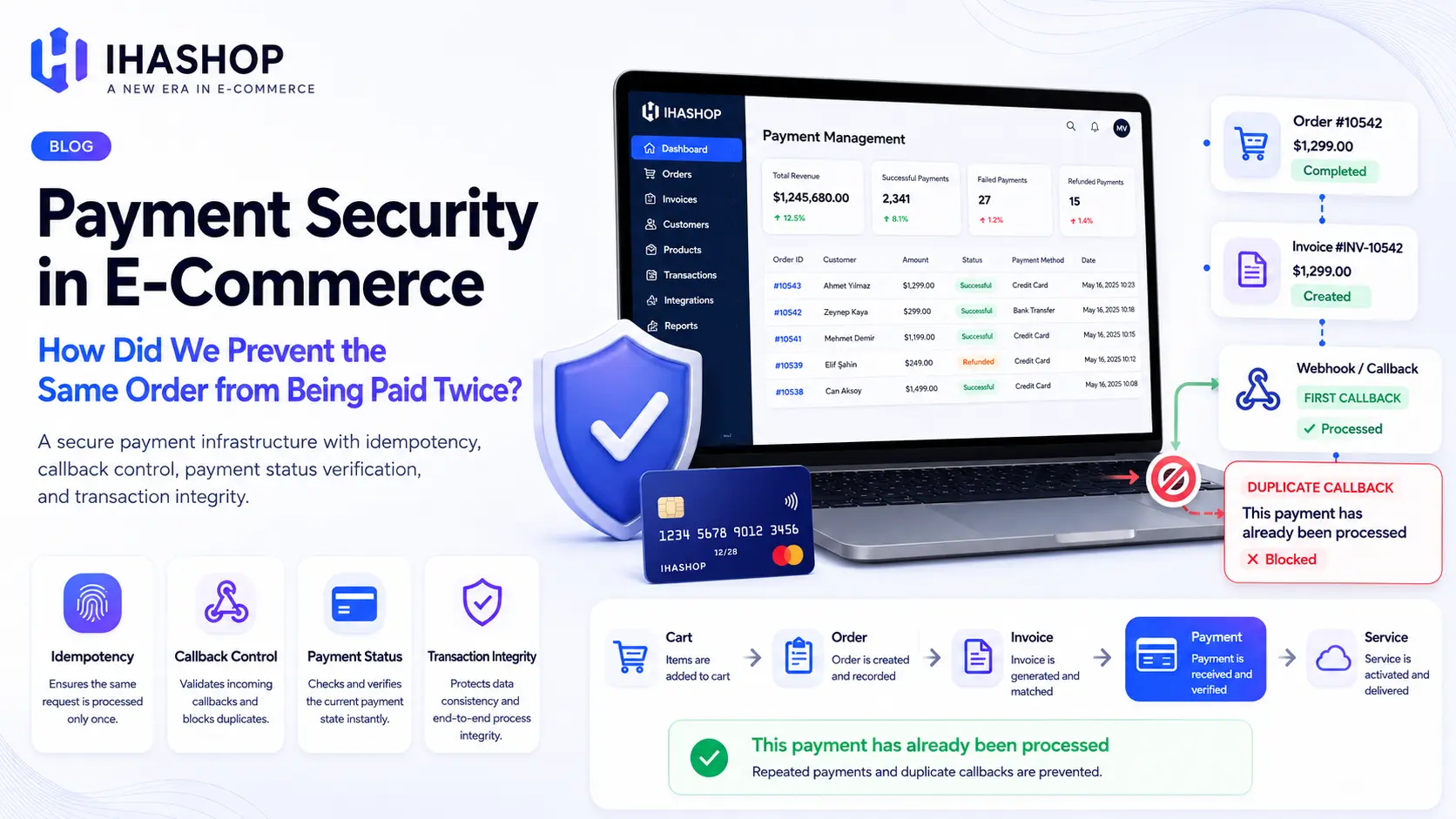
A payment provider may also send the result to the e-commerce platform through a server-to-server callback or webhook notification.
There is an important distinction here:
Receiving the same callback twice does not mean the customer has necessarily been charged twice.
The real risk is that the e-commerce platform may treat the same successful payment event as a new transaction for a second time.
For example, after the first notification, the system may already have completed the following chain:
Order → Payment → Invoice → Service Activation
If the same notification arrives again and there are no sufficient safeguards, the order, payment, or service preparation processes may run again.
The Real Problem We Addressed in IHASHOP
While developing the IHASHOP payment infrastructure, we did not focus only on the question, “Was the payment successful?”
Our main question was:
If the same payment event reaches the system more than once, will the final result change?
Our goal was to make sure that the same event produces a commercial result only once, no matter how many times it reaches the system.
For this reason, we reviewed the entire flow:
Cart → Order → Invoice → Payment → Fulfillment
We implemented controls designed to prevent:
- a second order from being created from the same cart,
- the same order from being processed as paid again,
- the same callback from triggering payment finalization again,
- the same manual payment from being approved twice,
- duplicate fulfillment tasks from being created.
What Is Idempotency?
The foundation of this approach is idempotency.
In simple terms:
If repeating the same operation does not create a new or duplicate result, the operation is idempotent.
The expected behavior in a payment system is:
First notification:
Payment successful → order updated.
If the same notification arrives again:
This payment has already been processed → do not create a new transaction.
The core principle is:
No matter how many times the same payment event reaches the system, the same commercial transaction should produce a result only once.
1. We Prevented the Same Cart from Creating a Second Order
Duplicate transaction risk can begin even before the payment provider is involved.
A customer may click the payment button twice, refresh the page, or the browser may repeat the same request.
For this reason, once a cart has been successfully converted into an order in IHASHOP, it should not be processed through the same conversion flow again.
This helps prevent a second order from being created from the same purchase intent.
2. We Protected Order, Invoice, and Payment Integrity
Duplicate records are not the only risk in payment systems. Partially completed transactions can also create serious problems.
For example, an order may be created while invoice creation fails. Or the process may stop before the payment record is completed.
In such cases, commercial records may become inconsistent.
For this reason, related operations should be handled as part of a controlled transaction flow.
The objective is simple:
The transaction should either complete as a whole or avoid leaving incomplete commercial records behind.
In payment security, it is not enough to ask, “Was the money received?”
You also need to ask:
Are the order, invoice, and payment records consistent with each other?
3. We Do Not Process a Paid Order Again
One of the most important controls against duplicate callbacks is the current payment status.
If an order has already successfully reached paid status, receiving the same payment notification again does not represent a new commercial event.
The system therefore checks the current status first.
If the order has already been paid:
- no new payment is created,
- the order is not processed again,
- payment finalization is not repeated,
- service activation is not triggered a second time.
This early check is one of the basic protection layers against duplicate processing.
4. Protection Is Not Limited to the Payment Record
Protecting only the payment record is not enough.
After a successful payment, other operations may begin, such as:
- license activation,
- domain operations,
- hosting preparation,
- theme or module entitlement,
- order fulfillment tasks.
Even if a second payment record is prevented, the system can still produce duplicate results if these operations are triggered again.
For this reason, IHASHOP extends duplicate protection from the payment layer into fulfillment processes as well.
5. The Same Rule Applies to Manual Payments
The same risk also exists with payment methods that require manual approval, such as bank transfers.
Once a payment has been approved by an administrator, repeating the same approval action should not trigger a second service activation.
The core rule is therefore independent of the payment method:
Whether a payment is finalized through an automatic callback or a manual approval, the same commercial event should never produce a second result.
Why Should You Not Rely Only on the “Payment Successful” Page?
The success page shown to the customer is part of the user experience, but it should not be the sole authority for determining payment status.
The customer may:
- close the browser,
- lose their internet connection,
- fail to complete the redirect,
- reopen the success page.
For this reason, the payment result should preferably be finalized based on a verified server notification from the payment provider and the actual payment status stored in the system.
Why Does This Matter to Store Owners?
Customers may never see these technical controls directly, but their effects are reflected in daily business operations.
A reliable payment lifecycle helps ensure:
- correct order statuses,
- consistent invoice records,
- prevention of duplicate service activation,
- fewer unnecessary customer notifications,
- cleaner accounting records,
- fewer support requests.
For this reason, idempotency is not merely a technical concept for developers.
It is one of the foundations of reliable payment and order management.
Our Approach to Payment Security in IHASHOP
At IHASHOP, we do not treat payment security as a single control.
At different stages of the payment lifecycle, we apply safeguards designed to prevent:
- the same cart from being converted into an order twice,
- order, invoice, and payment records from becoming inconsistent,
- a completed payment from being processed again,
- duplicate callbacks from creating a second commercial transaction,
- manual approvals from being repeated,
- duplicate fulfillment tasks from being created.
The goal is simple:
The system should behave predictably and securely when faced with repeated requests.
Questions to Ask When Choosing an E-Commerce Platform
When evaluating payment infrastructure, it is not enough to look only at which payment providers are supported.
You should also ask:
- What happens if the same callback arrives twice?
- Can a second payment record be created for the same order?
- What happens if the customer clicks the payment button twice?
- Can an already paid order be processed again?
- Can service activation be triggered a second time?
- Are order, payment, and invoice records consistent with each other?
The answers to these questions provide valuable insight into the true quality of the payment infrastructure.
Conclusion
Payment security in e-commerce is not limited to protecting card information.
How the system responds to the same event after a payment is completed is just as important as the payment screen itself.
The core principle of the IHASHOP payment infrastructure is:
No matter how many times the same payment event reaches the system, the same commercial transaction should produce a result only once.
From cart-to-order conversion to payment finalization and fulfillment preparation, idempotency and transaction integrity controls form the foundation of a more reliable payment experience.